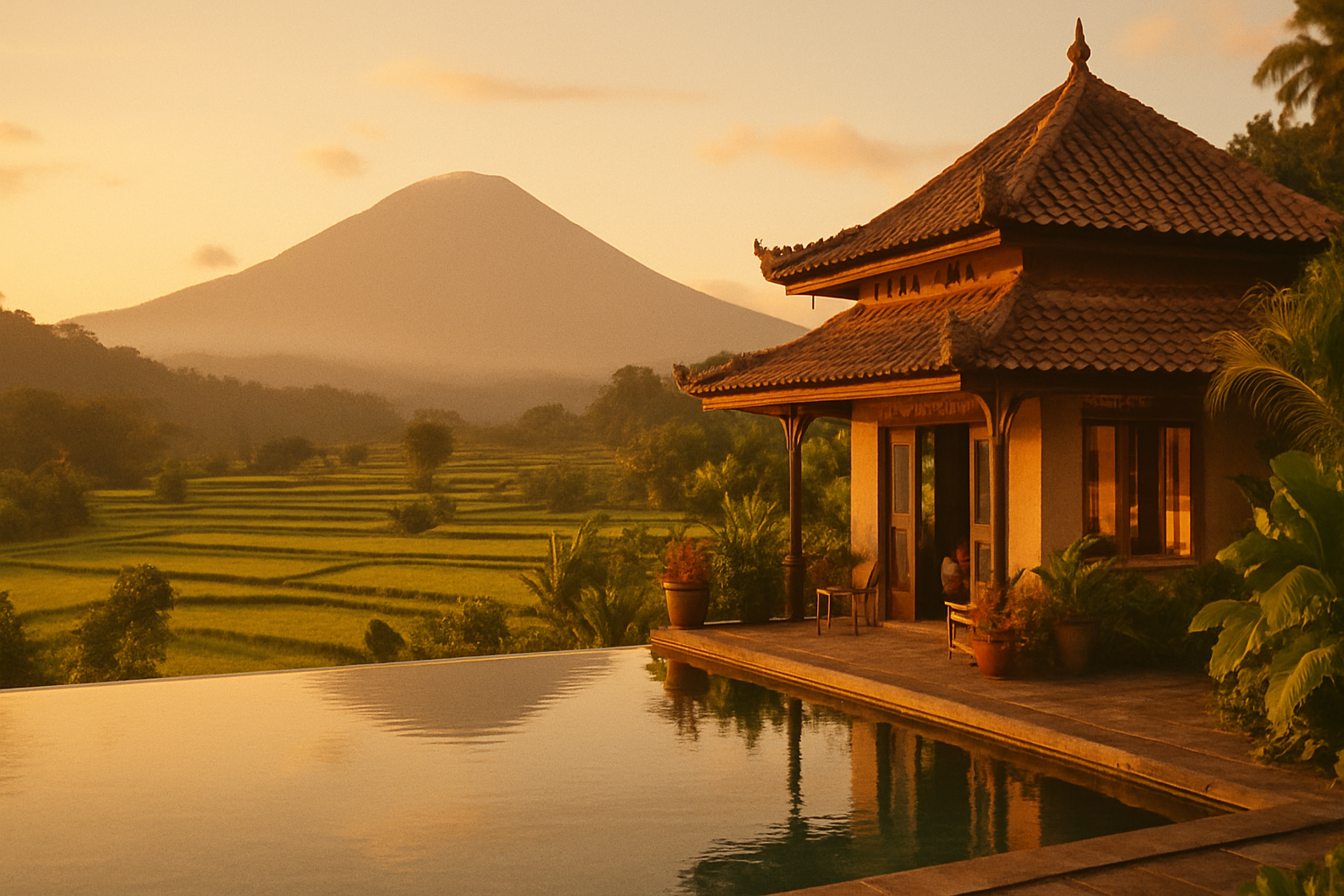
Trekking from Sidemen: Mount Agung Approaches and Valley Rice Field Walks
Sidemen sits at Agung's quieter shoulder, offering both a less-trafficked route to the summit and a network of valley walks that reward the unhurried traveller at every elevation.
Trekking from Sidemen: Mount Agung Approaches and Valley Rice Field Walks
Bali's highest peak dominates eastern Bali from almost every angle, but most trekkers approach Mount Agung from Besakih or Pura Pasar Agung — routes that are well-worn, well-guided, and increasingly busy. The approach from Sidemen sees a fraction of that traffic. Same mountain, different silence.
But Agung is not the only reason to lace up in Sidemen. The valley floor, the ridge trails above the village, and the approach paths through agricultural land offer some of the most varied trekking in east Bali — and most of it is accessible without a guide, without a fee, and without a 2 a.m. alarm.
The Valley Walks: Where to Start
The simplest entry point for any walk from Sidemen is Sidemen Village centre, where the main road narrows and the rice terraces open up to the west. From here, several grades of walk are available depending on your fitness level and time.
Easy: The River Path (1–2 hours, minimal elevation gain)
Head west from the village on any of the farm tracks descending toward the Unda River. The paths weave between paddies at different growth stages, crossing irrigation channels on bamboo bridges and passing through small clusters of family compounds. At the river itself, flat gravel banks make for easy walking north or south.
This is a genuine flat walk — appropriate for any fitness level, comfortable in sandals, and spectacular at any time of day. The main hazard is mud in the wet season; in the dry season it's simply one of the more pleasant hours you'll spend in Bali.
Moderate: Ridgeline to Iseh (2–3 hours, 200m elevation gain)
From the northern end of Sidemen, a track climbs east through dry forest and coconut groves to a ridge overlooking Iseh, a small hamlet that sits at roughly 500 metres. The views from the ridge take in the full width of Sidemen Valley with Agung in the background — genuinely among the finest landscapes in east Bali.
The Iseh hamlet itself is quiet and traditional; Walter Spies lived here in the 1930s and the landscape he painted is recognisably intact. A small warung near the hamlet offers cold drinks and a terrace view worth stopping for.
Return the same way or loop back via the valley floor for a circuit of approximately 4 hours total.
Challenging: Northern Valley to Muncan (4–5 hours, variable elevation)
The extended valley walk north through Muncan traverses a more remote section of the agricultural landscape. Trails are less distinct here and local knowledge becomes genuinely useful. A guide from any Sidemen guesthouse can lead this walk for IDR 150,000–250,000 — and will almost certainly know which family's durian orchard is currently producing.
Mount Agung: The Sidemen Approach
The Route
The Sidemen route to Agung approaches from the south-southeast, diverging from the Besakih route after the initial highland farmland section. It begins near Desa Sebudi, accessible from Sidemen via scooter or short drive, and proceeds through cloud forest to the summit ridge.
The total ascent is around 2,800 metres from the trailhead (Agung's summit sits at 3,142m, the trailhead at approximately 900–1,000m). The walk typically takes 5–7 hours up and 4–5 hours down.
Key characteristic of this route: fewer trekkers, more solitude, slightly more technical terrain above the cloud forest line. The exposed lava fields on the upper mountain require careful footing. Summit views — on clear mornings — extend to Lombok's Rinjani to the east and the full Bali interior to the west.
Timing and Season
Agung's summit routes close during major temple ceremonies, most notably during Eka Dasa Rudra (a major Besakih ceremony held roughly every hundred years, most recently 1979) and the frequent smaller purnama ceremonies at Besakih. Check with local guides or the Sidemen guesthouse network for current access status.
The dry season (May–September) is the reliable window for summit attempts — cloud cover above 2,000m is manageable and predictable. The shoulder months (April, October) are possible but unpredictable. The wet season summit attempt is not recommended: visibility is poor, the upper lava fields become hazardous, and Agung's microclimate intensifies rainfall dramatically.
Standard summit schedule from Sidemen: depart 11 p.m.–midnight, summit by 5–6 a.m. for sunrise, descend by noon before afternoon clouds build.
Guide Requirements
The Indonesian government requires all Agung summiteers to be accompanied by a registered local guide — this is not optional and is enforced at multiple points on the route. Registered Sidemen guides can be arranged through:
- Komang Agung Trekking — one of several guide operations based in the village
- Any reputable Sidemen guesthouse — most maintain relationships with 2–3 licensed guides
Guide fees for the summit via Sidemen: IDR 500,000–750,000 per person including basic equipment, water, and a headlamp if you don't have one. Bring your own trekking poles if you have them; the lava field descent is noticeably harder without them.
What to Bring
- Warm layers: summit temperatures at 3,000m regularly drop below 10°C, occasionally near freezing before dawn
- Trekking boots or serious trail shoes: not optional for the upper section
- 3 litres of water minimum
- Snacks with real calories: the ascent burns significantly more than most people expect
- Headlamp with fresh batteries
- A sense of proportion about the undertaking — Agung is a serious mountain and should be treated as one
Wildlife and Flora
Sidemen's trails pass through several distinct ecological zones. In the lower agricultural land: rice birds (manuk pare), monitor lizards (biawak) near water channels, occasional kingfishers over the river. In the mid-elevation forest on the way to Iseh: langurs, several species of hornbill, and in the early morning, the extraordinary call of the hill myna.
Above 1,500m on the Agung approach, the flora shifts to montane forest with significant tree ferns, moss-covered lava formations, and — in the right season — volcanic orchids growing directly from rock faces.
Getting to the Trailheads
Valley walks: begin directly from Sidemen Village. No transport required.
Ridge/Iseh walks: start from the northern end of the village; scooter rental available in the village if needed.
Agung via Sebudi: approximately 15–20 minutes by scooter north from Sidemen. Your guide will arrange the logistics of the approach if you book through them.
Sidemen offers a trekking spectrum that few corners of Bali can match: from a flat morning walk between paddies to one of Indonesia's most demanding day ascents, all staged from the same quiet valley.
Plan your base at /region/sidemen.