Traditional Weaving in Sidemen: Endek, Songket and a Living Craft Tradition
In Sidemen, weaving isn't a cultural exhibit — it's a household practice that has outlasted centuries of change. Pull up a chair beside a backstrap loom and you'll start to understand why.
Traditional Weaving in Sidemen: Endek, Songket and a Living Craft Tradition
The sound arrives before the sight: a rhythmic wooden percussion, steady and unhurried, coming from inside a family compound. You slow down. Through the gate, in the shade of the pavilion, a woman in her fifties works a backstrap loom with the fluid, unconscious precision of someone who has done this since childhood. The thread is silk. The pattern is geometric and dense. The cloth she's making will eventually become a ceremonial endek worn at a temple festival.
This is Sidemen on an ordinary Tuesday.
Why Sidemen?
East Bali's weaving tradition is concentrated in several villages, but Sidemen and the surrounding sub-district have emerged as the area most accessible to visitors seeking genuine craft encounters. The combination of a strong local tradition in both endek (silk ikat) and songket (supplementary weft weaving with metallic thread), proximity to reasonable accommodation, and a community of weavers who have — so far — maintained their practice outside the export-craft economy makes Sidemen distinctive.
Unlike the heavily commercialised weaving villages near Ubud, where demonstrations are staged for tour groups, most production in Sidemen happens within family compounds for family use or local ceremonial demand. The tourist footprint is light enough that the craft exists on its own terms.
The Two Main Traditions
Endek: Ikat Silk
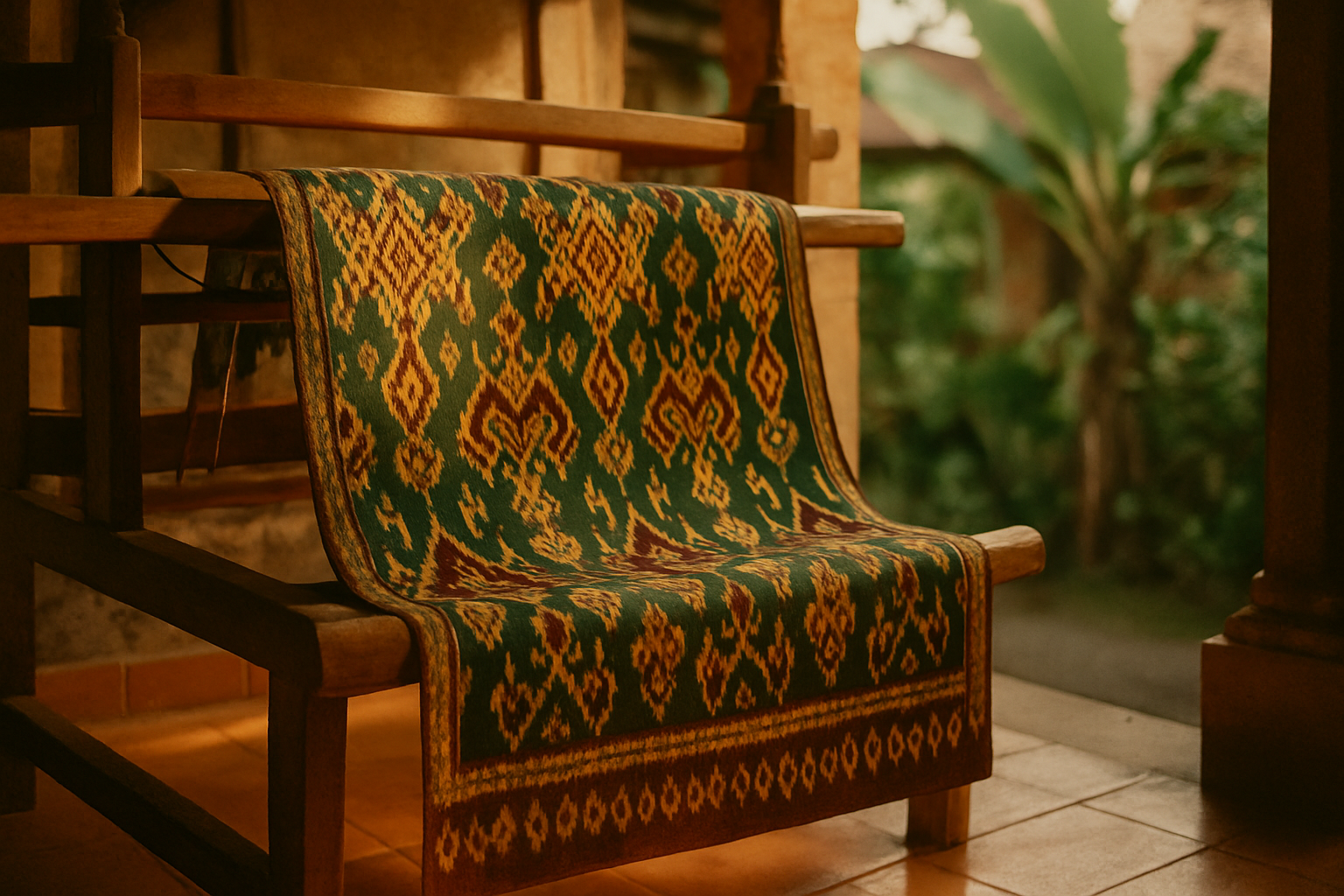
Endek is Bali's principal ceremonial textile: a silk (or synthetic silk) fabric distinguished by its ikat technique, in which individual threads are resist-dyed before weaving. The dye pattern is set in the thread, not in the finished cloth — which means the weaver must stretch, bind, dye, unbind, and re-stretch the thread in precisely the right sequence before a single row is woven.
The results are characteristically soft-edged geometric or floral patterns, often in saturated jewel tones: deep indigo, saffron, crimson, forest green. Traditional endek uses natural dyes derived from indigo (tarum), turmeric, and bark, though synthetic dyes have largely replaced them for commercial production. In Sidemen, you can still find weavers using natural dye processes — ask specifically, and be prepared for a longer, more nuanced conversation about the difference.
Endek is worn at ceremonies throughout the Hindu calendar year. A standard kain (sarong length) takes one to two weeks to complete.
Songket: Thread of Gold
Songket is technically and economically a different proposition. Where endek uses coloured silk for its pattern, songket introduces supplementary weft threads of real or imitation gold and silver, creating a raised, luminous surface pattern against a plain-woven ground.
Sidemen Songket commands the highest prices and the longest production times: a quality piece using real metallic thread can take three to six weeks and sells for IDR 1,500,000–5,000,000 or more. The technique is associated with Balinese royalty and is still considered appropriate for weddings and major religious ceremonies only.
Watching a songket weaver work at a manual floor loom — managing three or four thread systems simultaneously, counting heddles, maintaining tension — is one of the more quietly astonishing craft spectacles in Bali.
Visiting the Workshops
Pelangi Weaving on the main Sidemen road is one of the larger family operations and the most visitor-ready: looms are set up in an open pavilion, and someone is almost always working during daylight hours. There is no entrance fee, though buying something is both appropriate and genuinely worthwhile.
UD Wiranadi is a smaller compound a short walk north, specialising in songket and offering a more concentrated lesson in the metallic-thread technique if you ask.
For the most authentic encounters, walk the smaller lanes off the main road. In family compounds throughout the village you'll see looms under pavilion roofs — a gentle knock and a gesture toward the loom is usually enough to be invited in for a look. Bring a genuine curiosity and no time pressure.
A few local guesthouses can also arrange morning visits to weaving families who don't otherwise receive visitors, with a guide who speaks both Balinese and Indonesian. These tend to be more instructive and more personal than the roadside workshops.
What to Look for When Buying
The Sidemen market for woven cloth is honest compared to Kuta or Seminyak, but a few guidelines help:
Thread matters. Real silk has a distinctive lustre and drape; polyester endek is significantly cheaper (IDR 80,000–150,000 per metre versus IDR 300,000–600,000) and perfectly serviceable for casual wear, but the two are not equivalent. Hold the cloth to light and run it between your fingers.
Metallic thread in songket: real gold and silver thread is rare and expensive; most songket uses Lurex or similar synthetic metallics. This is disclosed by any reputable seller and is not a deception — synthetic metallic thread is traditional enough at this point to have its own aesthetic vocabulary. Ask about the thread and the seller will tell you.
Pattern authenticity: certain geometric patterns (poleng, perada, cepuk) have specific ceremonial meanings. A good seller can explain what a pattern is used for, which is itself a useful indicator of knowledge and care.
Fair prices: for a handwoven endek kain of silk with natural dyes, IDR 400,000–800,000 is a reasonable range depending on complexity. For songket, IDR 600,000 on the low end for a simple pattern in synthetic metallic thread; IDR 2,000,000+ for complex work in real gold thread. Gentle negotiation (10–15%) is fine; aggressive bargaining is not, and will not earn you a better relationship with the maker.
The Cultural Significance
Weaving in Bali is not decorative. It is ritual infrastructure. Specific textiles are required for specific ceremonies at specific life stages: there is a cloth for a first tooth-filing, a cloth for a cremation, a cloth for a wedding, a cloth for the daily temple offering. Dewi Danu (goddess of the lake) and Dewi Sri (goddess of rice) are both associated with weaving in the local cosmology.
In Sidemen, many of the women who weave do so not for income but because the cloth they make will be worn by their own families at ceremonies they will attend together. This is the context that makes the workshops meaningful to visit: you are not watching a craft demonstration. You are watching a woman make something that will matter at a moment that matters.
Practical Notes
Best time to visit: mornings, when light is better and weavers are freshest. By early afternoon, the heat slows everything down.
Photography: always ask before photographing a weaver at work. Most will agree, but the asking is the point.
Getting there: Sidemen is about 1.5–2 hours from Ubud by car or scooter. The weaving workshops are concentrated along Jalan Sidemen and the lanes immediately off it.
What to bring home: a length of endek for a sarong is the most practical purchase — light, versatile, and meaningful. A songket selendang (sash) works as a table runner or wall textile at home.
Sidemen's weaving tradition is neither frozen nor disappearing. It is, against the odds, simply continuing — which is the most remarkable thing about it.
Discover more of Sidemen's culture at /region/sidemen.