Brahma Vihara Arama: Bali's Buddhist Monastery and the Lovina Temple Circuit
Bali's only Buddhist monastery stands in the hills above Lovina, its golden stupas and pan-Asian architecture unlike anything else on the island. Pair it with the Hindu temples of the north coast for one of Bali's most quietly profound cultural days.
A Monastery That Stops You
The road to Brahma Vihara Arama climbs into the hills above Banjar village, past terraced gardens and small Hindu shrines, until a gate appears flanked by two enormous golden statues. You park the scooter. You wrap a sarong. You walk in — and then you stop, because nothing in your Bali itinerary has prepared you for this.
The monastery is Thai in its golden roof lines, Tibetan in its prayer hall paintings, Balinese in the carved stone details and the surrounding jungle — and the synthesis is not awkward. It is, somehow, entirely coherent. This is what makes Brahma Vihara Arama one of the most architecturally surprising places in Bali.
Bali's Only Buddhist Monastery
Vihara Dharma Giri — also known as Brahma Vihara Arama — was established in 1970, making it a relatively young institution in a landscape of ancient temples. It was founded under the guidance of the late Bhante Girirakkhito Mahathera, a prominent Indonesian Buddhist monk, and has since grown into a functioning monastic community and a place of active pilgrimage.
Bali is overwhelmingly Hindu — roughly 87% of the island's population follows Agama Hindu Dharma — which makes a Buddhist monastery here unusual enough to warrant explanation. The monastery exists in a spirit of coexistence that is characteristic of Balinese religious culture, where animist, Hindu, and Buddhist traditions have been woven together for centuries. The monks here follow the Theravada tradition, and the complex is used for meditation retreats, religious education, and daily prayer practice.
It is a real, working monastery — not a tourist attraction that has adopted the label.
The Architecture: A Pan-Asian Synthesis
The complex is built on a hillside with multiple levels connected by stone staircases. Allow at least 45 minutes to explore properly.
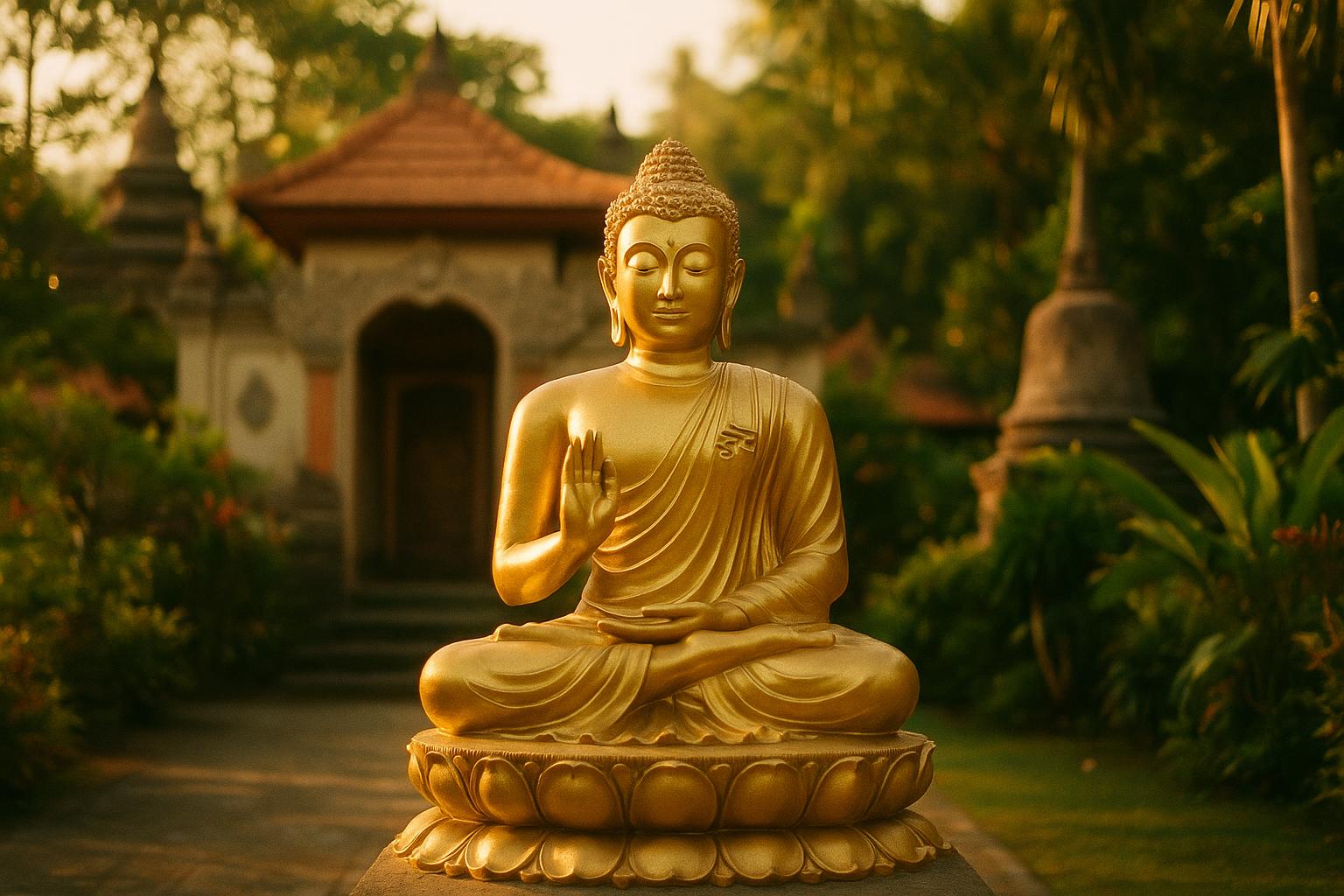
Main prayer hall: The centrepiece of the monastery, with a gold-roofed exterior that would not look out of place in Chiang Mai. Inside, a large gilded Buddha sits beneath paintings that mix Thai mural traditions with Balinese decorative motifs. The hall is open to visitors during non-service hours; silence is expected.
The stupas: Several whitewashed stupas in the Tibetan style are scattered across the upper grounds, some with small meditation alcoves. The largest overlooks the valley below — on a clear morning the view extends toward the coast and the flat Bali Sea beyond.
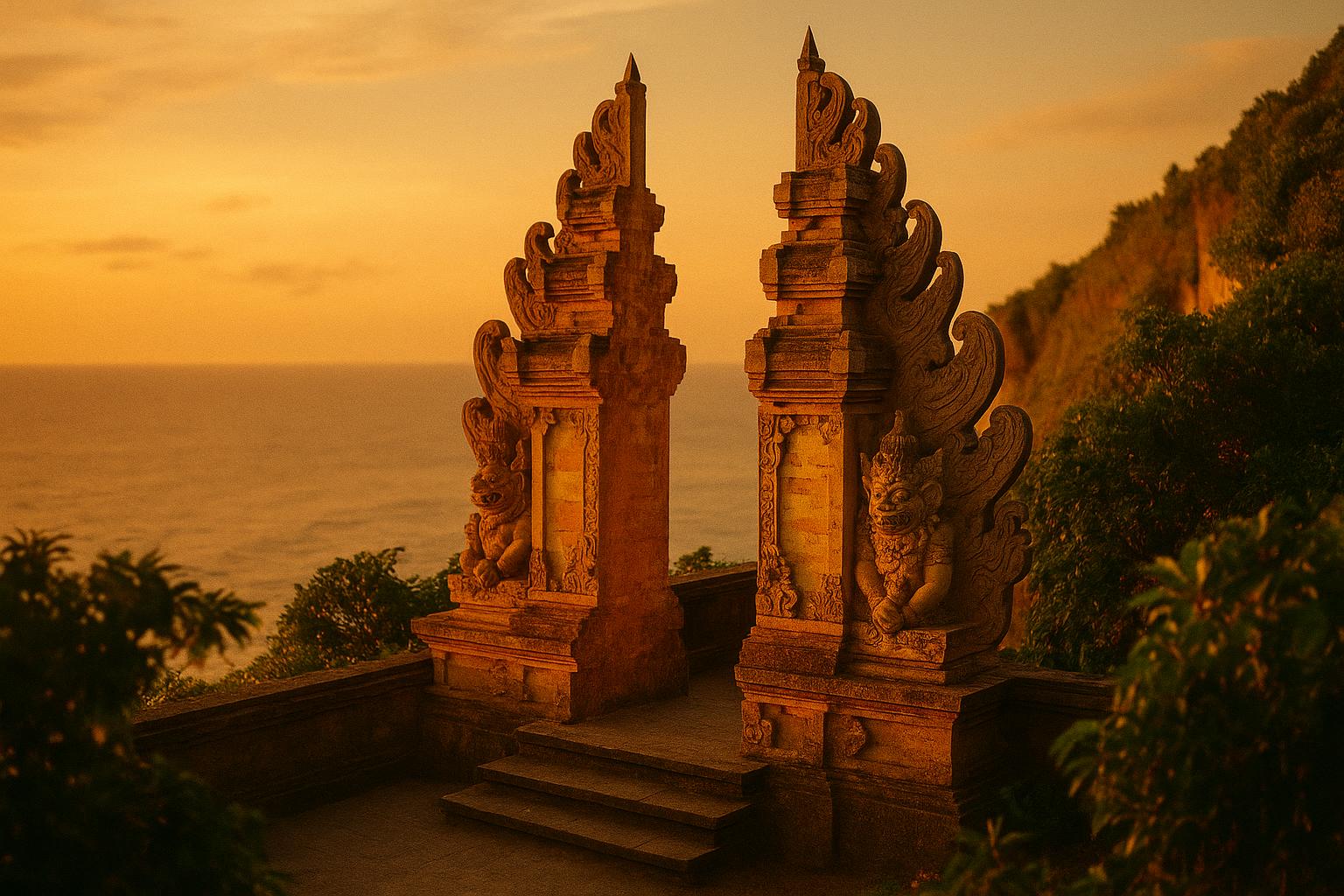
Balinese stone carvings: The gateways, balustrades, and garden statues are executed in the distinctive style of north Balinese craftsmen — more angular and densely detailed than the southern Ubud style. Kala faces, nagas, and floral motifs cover almost every surface.
The garden: Landscaped with tropical plantings, koi ponds, and frangipani trees. Monks tend the grounds in the early morning. The scent of incense and flowers is constant.
Visiting: What You Need to Know
Getting there: About 12 km southwest of central Lovina, 5 minutes above the Banjar Hot Springs on the same road. The two sites are almost always combined — hot springs in the morning, monastery in the late morning or early afternoon.
Dress code: Strict. Shoulders and knees must be covered. Sarongs are available at the gate (required, not optional). Remove shoes before entering the prayer hall. Photography is allowed in the grounds but not inside the prayer hall during active ceremonies.
Hours: Generally 8:00 am – 5:00 pm daily, though monks' ceremony times may restrict access to certain areas. There is no fixed entrance fee — donations to the monastery are appropriate (IDR 20,000–50,000 is standard).
Behaviour: This is an active religious site. Keep voices low. Do not touch offerings or altar items. Do not enter areas marked as restricted. Follow the lead of any monks present.
The Lovina Hindu Temple Circuit
Brahma Vihara Arama sits within a broader network of Hindu temples that define the spiritual landscape of north Bali. A half-day circuit that begins at the monastery and moves along the coast reveals a side of the region that most Lovina visitors miss entirely.
Pura Pulaki — one of the most dramatically sited temples in north Bali, built directly into a rocky coastal cliff with the sea on three sides. Sacred long-tailed macaques live in the temple grounds — approach with caution and keep bags closed. Located about 25 km west of Lovina, easily combined with a trip toward Pemuteran.
Pura Meduwe Karang — in Kubutambahan, east of Lovina, this is one of the finest examples of north Balinese temple carving in existence. The bas-relief that depicts a Dutch botanist riding a bicycle (a figure carved by local craftsmen who had apparently never seen one) is justifiably famous. Worth the 12 km detour.
Pura Dalem Jagaraga — a smaller village temple known for its extraordinary exterior carvings depicting scenes of Dutch colonial life alongside traditional Balinese iconography: a car, a biplane, Dutchmen being devoured by sea monsters. A subversive masterpiece in stone.
The dolphin statue roundabout — not a temple, but a landmark: the large bronze dolphin statue at the centre of Kalibukbuk village in Lovina. It marks the heart of the town and serves as a useful orientation point when navigating between the beach, the main road, and the accommodation strip.
Holy Water and Living Ritual
One aspect of north Bali temple culture that visitors rarely anticipate is the role of tirtha — holy water — in daily practice. Several temples in the Lovina area have active water springs considered sacred, and priests from across Bali make pilgrimages to collect water from these sites for ceremonies. If you arrive at a temple during an active ceremony, you may witness the preparation of tirtha: prayers, offerings, flower petals, and incense preceding the blessing of the water that will be carried home.
This is not performance. It is the ongoing liturgy of Balinese Hinduism — a calendar-dense, community-embedded religious life that runs in parallel with the tourist economy and remains largely indifferent to it.
Our [/region/lovina] guide has more on the cultural calendar of north Bali and the best times to visit for festival season. For the coastal temples, the road west toward [/region/pemuteran] passes several more worth stopping for.