Mount Agung: Bali's Sacred Volcano and the Sunrise Trek That Changes You
Bali's highest peak at 3,031 m is sacred, active, and utterly spellbinding — here's everything you need to know.
The Sky-Piercing Giant at Bali's Heart
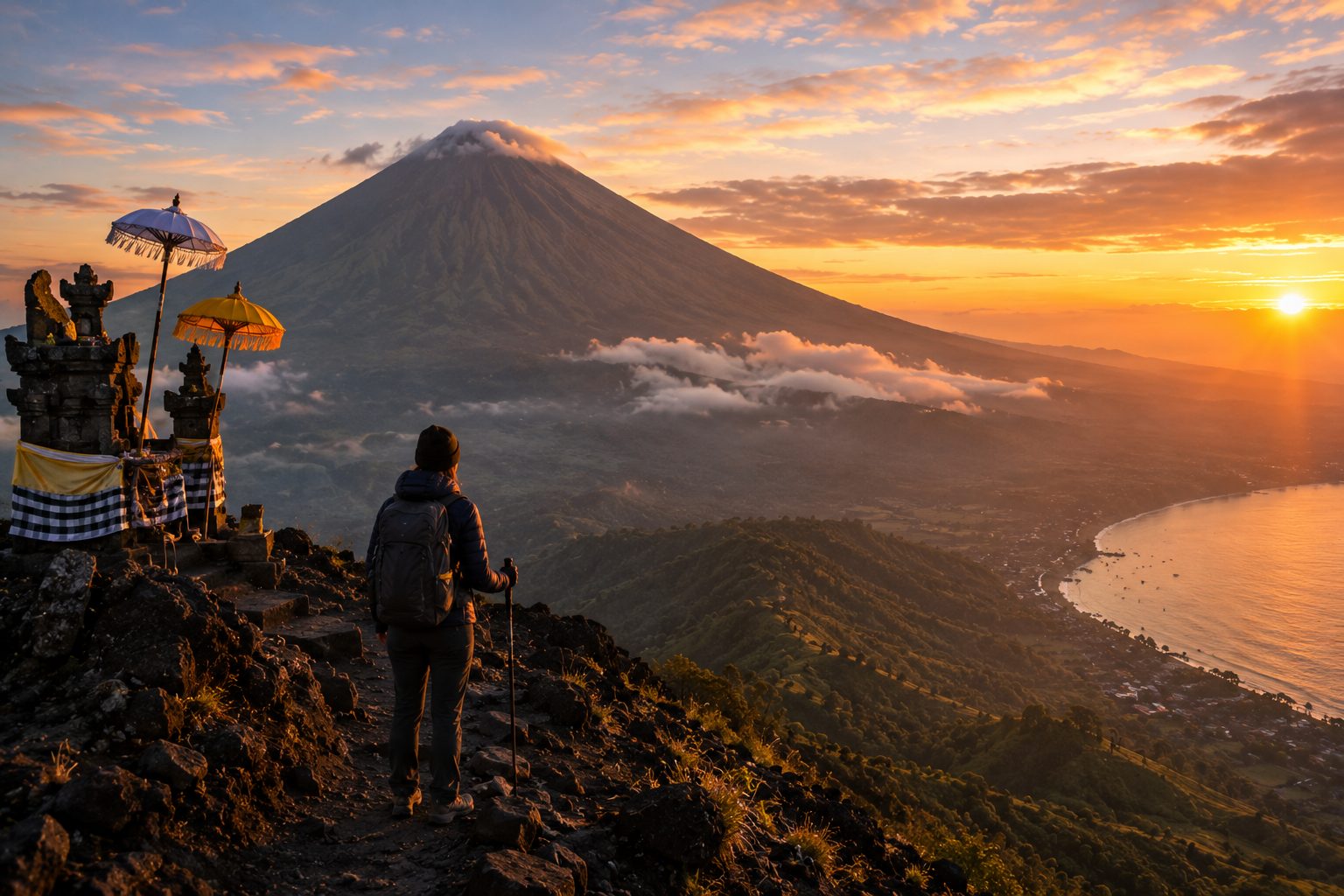
On a clear morning in Amed, before the fishing boats have left the shore and while the sea still holds the night's deep blue, you will see it: a perfect volcanic cone rising above the clouds, catching the first blush of gold. That is Gunung Agung — Mount Agung — and once you've seen it, it becomes impossible to look away.
At 3,031 metres, Agung is the highest point on the island and one of the most active volcanoes in Indonesia. It dominates the eastern skyline, defines the island's spiritual geography, and draws trekkers, pilgrims, and dreamers from every corner of the world. This is not just a mountain. For the Balinese, it is the centre of everything.
The Volcano of the Gods: Spiritual Meaning & Pura Besakih
In Balinese Hinduism, Gunung Agung is far more than geology. It is the earthly replica of Mount Meru — the cosmic axis that connects the world of humans to the realm of the divine. The gods reside here. The soul of the island pulses from this summit.
Every home, every rice field, every temple on Bali is oriented in relation to Agung. The direction kaja — toward the mountain — is the sacred direction, the direction of the gods. You feel this alignment everywhere once you know to look for it.
Climbing the volcano's lower slopes at around 900 metres is Pura Besakih, known across the archipelago as Bali's Mother Temple. It is not a single temple but a vast complex of 23 interconnected shrines, the oldest dating back to the 10th century, cascading up the mountainside in tiered black-stone towers wrapped in smoke from perpetual offerings. At least 70 ceremonies are held here each year. If you visit during a major festival — Galungan, Kuningan, or one of the shrine's own odalan anniversaries — you will witness something that belongs to the realm of the extraordinary: thousands of Balinese in white and yellow batik, carrying towering offerings, filling the air with incense and the sound of gamelan.
Visitors are welcome, but respectful dress is non-negotiable — a sarong is mandatory and can be hired at the entrance. Certain inner sanctums remain reserved for Hindu worshippers. Read the guidance, follow your guide, and tread gently: you are a guest in a living sacred space.
The Sunrise Trek: Climbing Agung in the Dark
To stand on the rim of Agung's crater as the sun breaks the horizon over the Java Sea — with all of Bali laid out far below you, still wrapped in shadow — is one of the most visceral experiences the island can offer. It is earned, not given.
There are two main routes to the top:
Route 1 — Pura Pasar Agung (Most Popular)
This trail starts from the small temple of Pura Pasar Agung on the southern flank. The elevation gain is approximately 1,500 metres over 4–5 hours of steep, unrelenting ascent through forest and then bare volcanic rock. You reach the southern crater rim at around 3,031 metres — not the absolute true summit, but high enough for views that will hollow you out with their beauty. Round trip is roughly 8 hours.
Route 2 — Besakih (Full Summit, Expert Level)
Starting from the Mother Temple itself, this route climbs to the true highest point at 3,142 metres with a brutal elevation gain of over 2,100 metres. Expect 10–12 hours round trip. This is a route for experienced, fit hikers only.
Both routes require a certified local guide — this has been a formal requirement since January 2025, enforced strictly, with unauthorised solo hikers facing deportation. Book through a reputable trekking operator in Amed or Sidemen. Your guide handles the safety logistics, the pre-dawn navigation, and the cultural protocols at the trailhead temples.
Treks typically begin with a late-night pickup (around 11 pm) to reach the trailhead by midnight and summit around 5–6 am. Bring warm layers — it gets genuinely cold near the top — and a good headlamp. The best season is April through October, when skies are clear and trails are drier.
Where to Admire Agung Without the Climb
Not every encounter with Agung needs to involve a headlamp and burning quads. The mountain rewards contemplation from below with equal generosity.
From Amed: You are essentially at the foot of the volcano, and its presence is constant. Morning is the moment — walk to the seafront before 7 am, when the air is still and the summit is perfectly clear, and you will understand why the Balinese treat this view as a daily blessing.
From Sidemen: The rice terraces of this lush inland valley frame Agung like a painting. Come in the morning for the clearest skies. Sidemen is one of the quieter corners of east Bali, and the combination of vivid green paddies and the volcano's dark silhouette has a quality that is almost painfully beautiful.
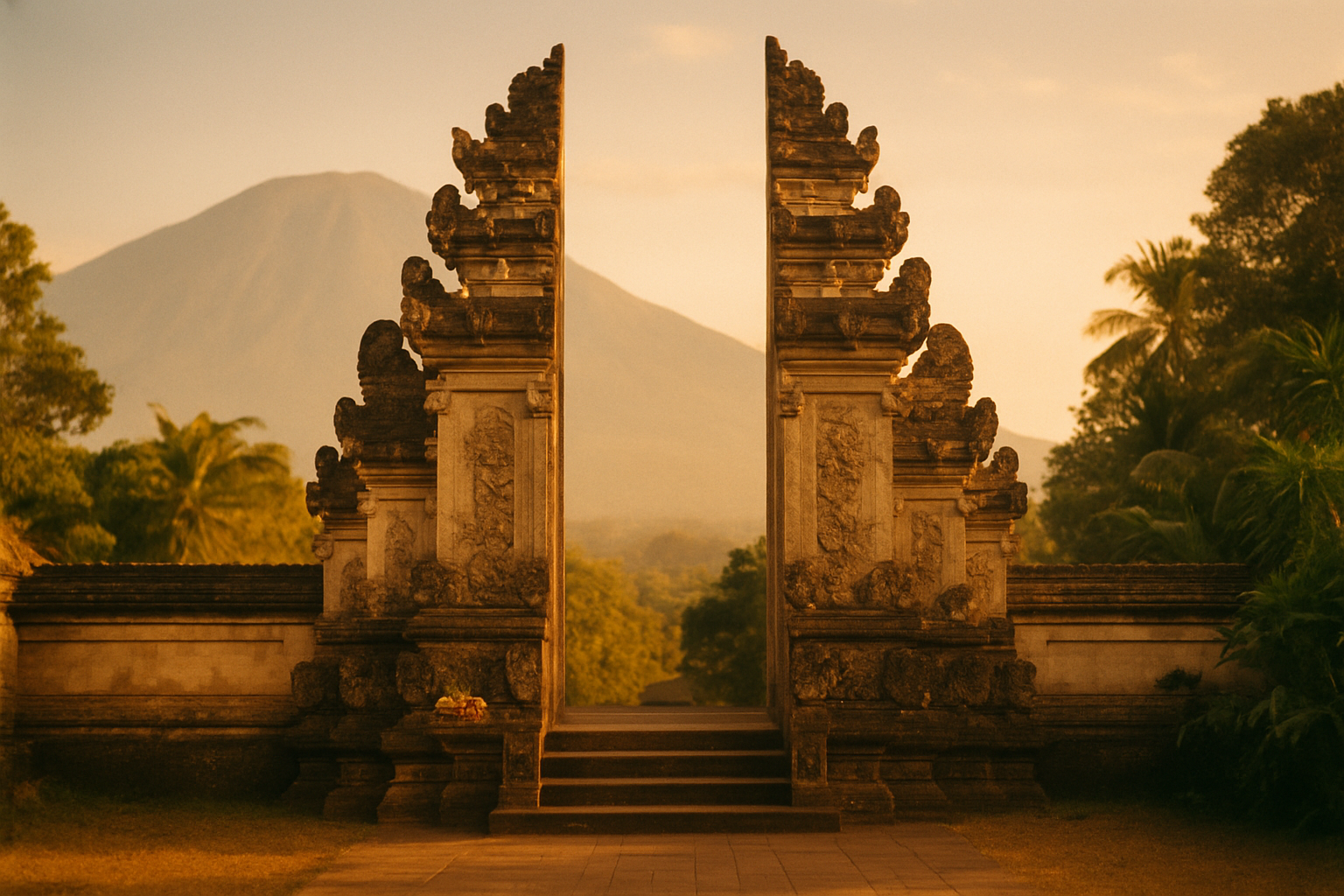
From Pura Lempuyang (Gates of Heaven): Roughly 30 minutes from Amed, the ancient split gate of Lempuyang Temple frames Agung with theatrical perfection. The reflection of the volcano in a shallow mirror pool below the gateway has become one of Bali's most iconic images. Come early — this place draws crowds by mid-morning — and take the time to climb the full pilgrimage route to the uppermost temple, where the views are quieter and the atmosphere more genuinely devotional.
Respect, Safety & Practical Notes
Agung is an active volcano. Its most violent eruption in living memory struck in 1963, killing an estimated 1,100 people and reshaping the landscape for years. The 2017–2019 eruption cycle triggered the evacuation of 40,000 people and disrupted international flights on multiple occasions.
The mountain's alert level is monitored continuously by Indonesian authorities (PVMBG). When the level rises, trekking is suspended entirely — this can happen with little notice. Always check current conditions before booking a climb, and book only with operators who monitor official alerts and will cancel or reroute without hesitation.
The mountain also closes during major religious ceremonies. This is not an inconvenience — it is the mountain reminding you of its primary identity. On those days, find your spot in Amed and watch the clouds move around the summit at golden hour. That, too, is the real Bali.
The Mountain That Defines the Island
Gunung Agung is not background scenery. It is a living presence — geological, spiritual, and deeply human all at once. Whether you stand at its crater rim in the half-dark of dawn or simply watch it glow from a beach chair in Amed as the sun sets behind you, it will leave a mark. Bring your reverence. You won't regret it.