Day Trips from Sidemen: Besakih, Tirta Gangga and the Temples of East Bali
East Bali's sacred sites radiate from Sidemen like spokes — Besakih to the north, Tirta Gangga to the east, Lempuyang against the dawn sky. Here's how to see them without sacrificing the valley.
Day Trips from Sidemen: Besakih, Tirta Gangga and the Temples of East Bali
One of Sidemen's underappreciated advantages is its position in the east Bali cluster: within 45 minutes of the valley, you have access to three of the island's most significant sacred sites and a number of smaller temples and royal water gardens that most tourists never reach. Sidemen makes an excellent base for a dedicated two or three-day circuit of east Bali — or for a series of morning excursions between lazy afternoons watching the paddies.
Here's the full picture of what's reachable, how long each takes, and how to organise it.
Pura Besakih: The Mother Temple
Pura Besakih is Bali's largest and most sacred temple complex — a collection of 23 related temples spread across the southwestern slope of Mount Agung at around 1,000 metres elevation. It has been a place of worship for over a thousand years and remains one of the most religiously active sites in the Hindu Balinese world.
From Sidemen, Besakih is approximately 45 minutes by scooter or car — a straightforward drive north along the valley road and then northwest on the Besakih approach road. The altitude means temperatures are noticeably cooler than the coast; bring a layer.
What to expect: Besakih is genuinely impressive at scale — the main padmasana throne rises high above a series of ascending courts, and the complex extends across the hillside in a way that maps are inadequate to convey. It is also, candidly, one of Bali's more challenging visitor experiences. The "guide" situation at the entrance has been a point of traveller friction for decades: unofficial guides will insist you cannot enter without them (this is not true for the outer areas) and that you must hire them and purchase a sarong rental. The recommended approach is to arrive with your own sarong and politely decline, acknowledge, and move past any persistent offers at the gate.
The temple is closed to non-Hindu visitors during ceremonies, which occur regularly — check with your guesthouse the day before.
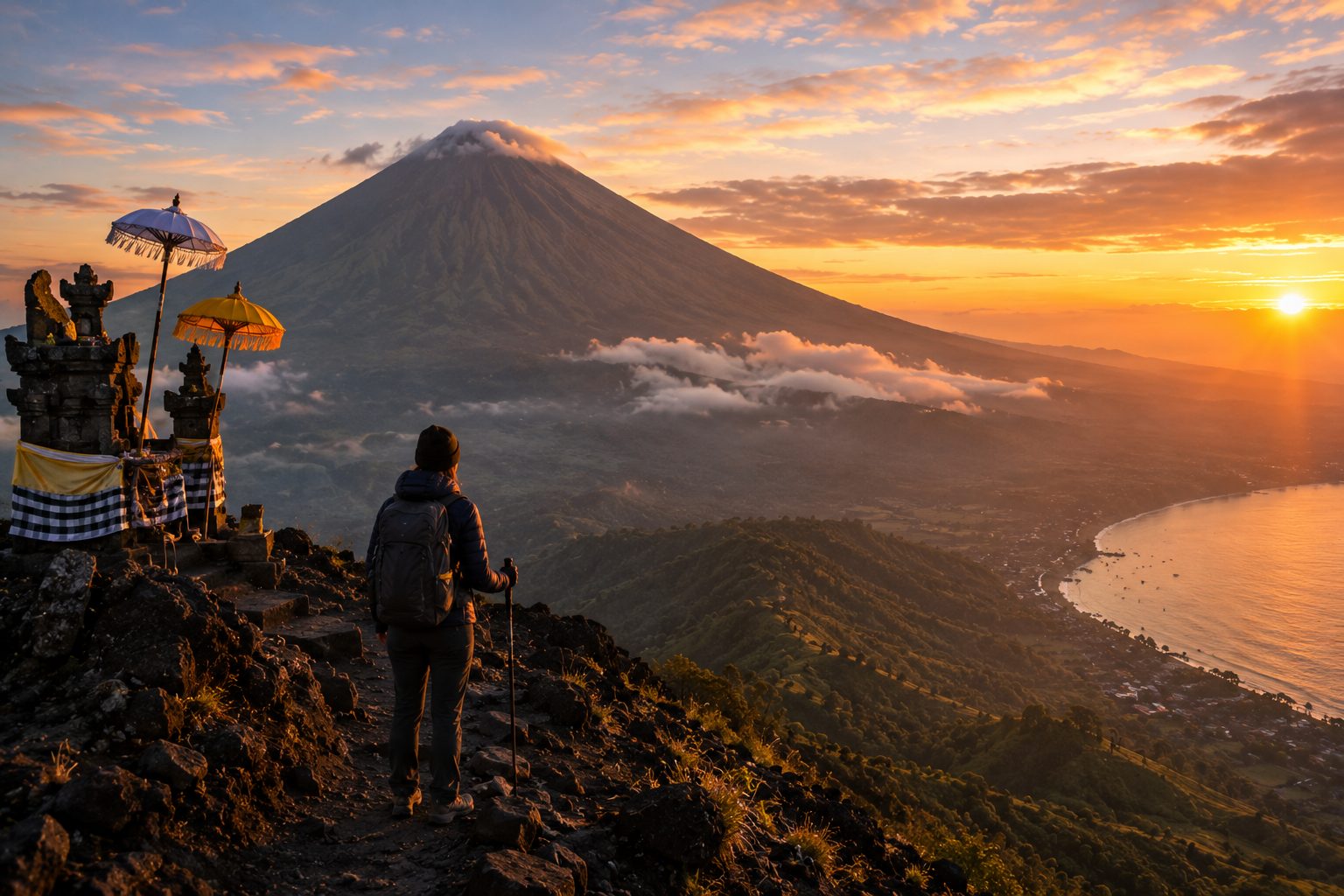
Best time to visit: early morning (7–8 a.m.) before tour buses and before cloud obscures Agung's peak above the temple. A clear morning at Besakih, with the mountain visible behind the tiered meru roofs, is one of the definitive east Bali images.
Entrance fee: approximately IDR 60,000 per person. Sarong and sash rental at the gate if needed.
Tirta Gangga: The Royal Water Palace
Tirta Gangga is a former royal garden-palace built by the last Raja of Karangasem in 1948, featuring ornate pools fed by natural springs, stone bridges, sculpted fountains, and elaborate Balinese stonework set against rice terraces and mountain backdrop.
From Sidemen, Tirta Gangga is approximately 30 minutes east — drive through Selat and continue to Abang. This is one of the most photogenic sites in Bali and receives significantly fewer visitors than its importance warrants, largely because it requires a dedicated trip east rather than falling en route between popular tourist nodes.
What to see: the main complex consists of three tiered pools — one swimmable (the lower pool is available to visitors for IDR 50,000 extra, a worthwhile addition on a hot day), surrounded by stepping-stone paths, koi-filled channels, and stone sculpture. The surrounding garden paths extend into the rice terraces beyond the main complex and can be walked for another 30–40 minutes.
Entrance fee: approximately IDR 50,000; IDR 50,000 additional to swim.
Combine with: a late breakfast or early lunch at one of the small warungs flanking the main entrance. Cafe Tirta Ayu, set directly beside the pools inside the complex, has arguably the most extraordinary setting of any restaurant in east Bali — a full breakfast beside ancient stone fountains with Agung visible to the west.
Pura Lempuyang: The Gates of Heaven (and the Queue)
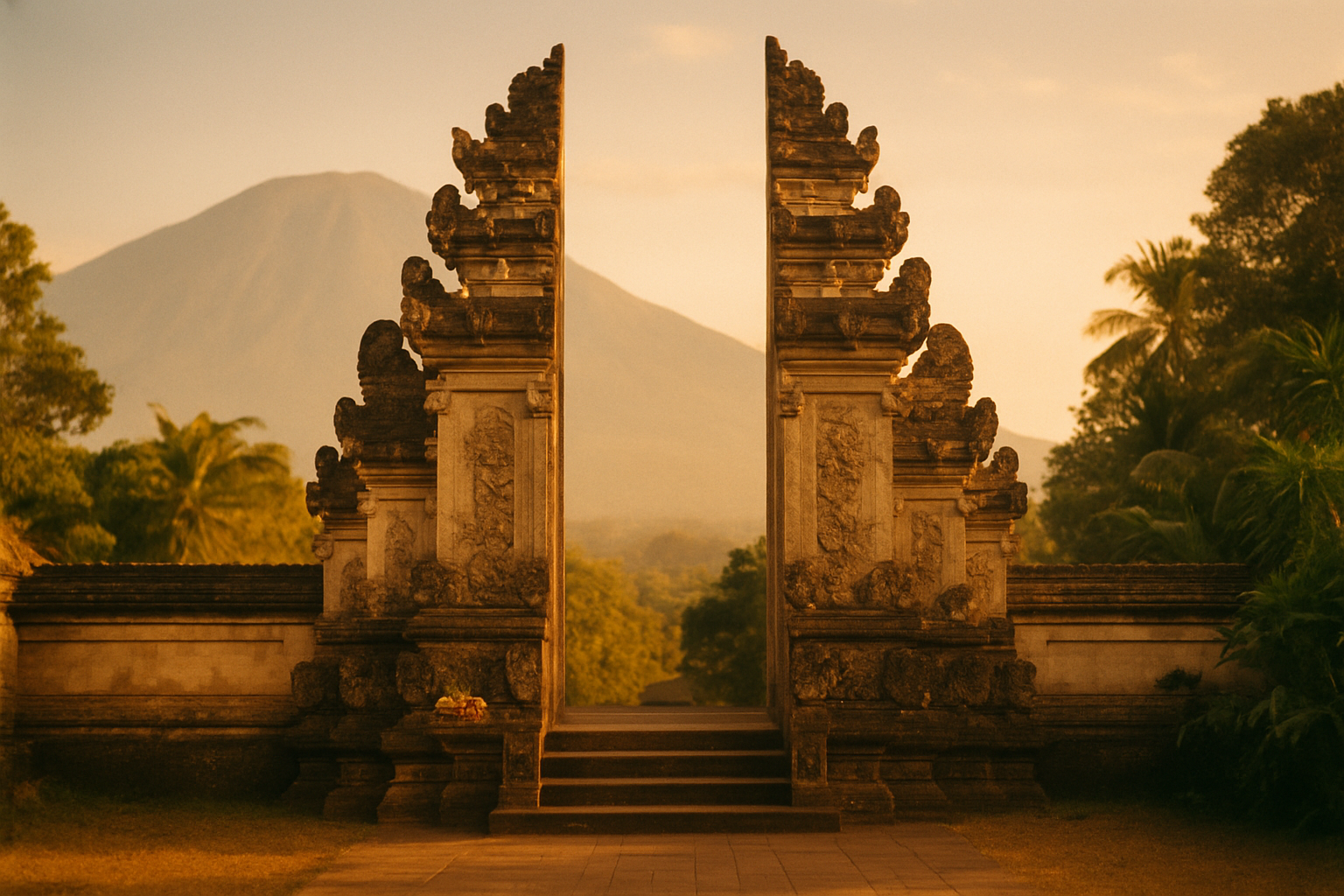
Pura Lempuyang Luhur has become globally famous for a single photograph: the split gates (candi bentar) of the lower temple framing Agung in perfect symmetry, often reflected in a pool of water placed by a photographer with a mirror. The image is ubiquitous and the queue to take it, on a typical dry-season morning, runs to 2–3 hours.
From Sidemen, Lempuyang is approximately 45–50 minutes east via Tirta Gangga, making it straightforwardly combinable with the water palace in a single day.
The honest visitor's note: the "reflection pool" is a photographer's prop — a tray of water placed and held by a guide for a fee. The actual gates are extraordinary without it; the surrounding complex extends 1,700 steps up the mountain to seven temples at increasing elevation, almost none of which are visited by the tour-bus crowd. If you have the legs and the time, climbing past the gate photo queue to the higher temples reveals a genuinely wild, cloud-forested pilgrimage route that bears no resemblance to the Instagram spectacle at the base.
When to go: before 7 a.m. or after 3 p.m. significantly reduces the queue. The gate photograph faces west, so early morning light (golden hour behind you) and late afternoon light (warming the gate directly) are both photographically ideal — this naturally aligns with the quieter windows.
Dress code: full sarong and sash required; rentals available at the car park.
The Smaller Detours: Local Markets and Hidden Temples
Iseh Village
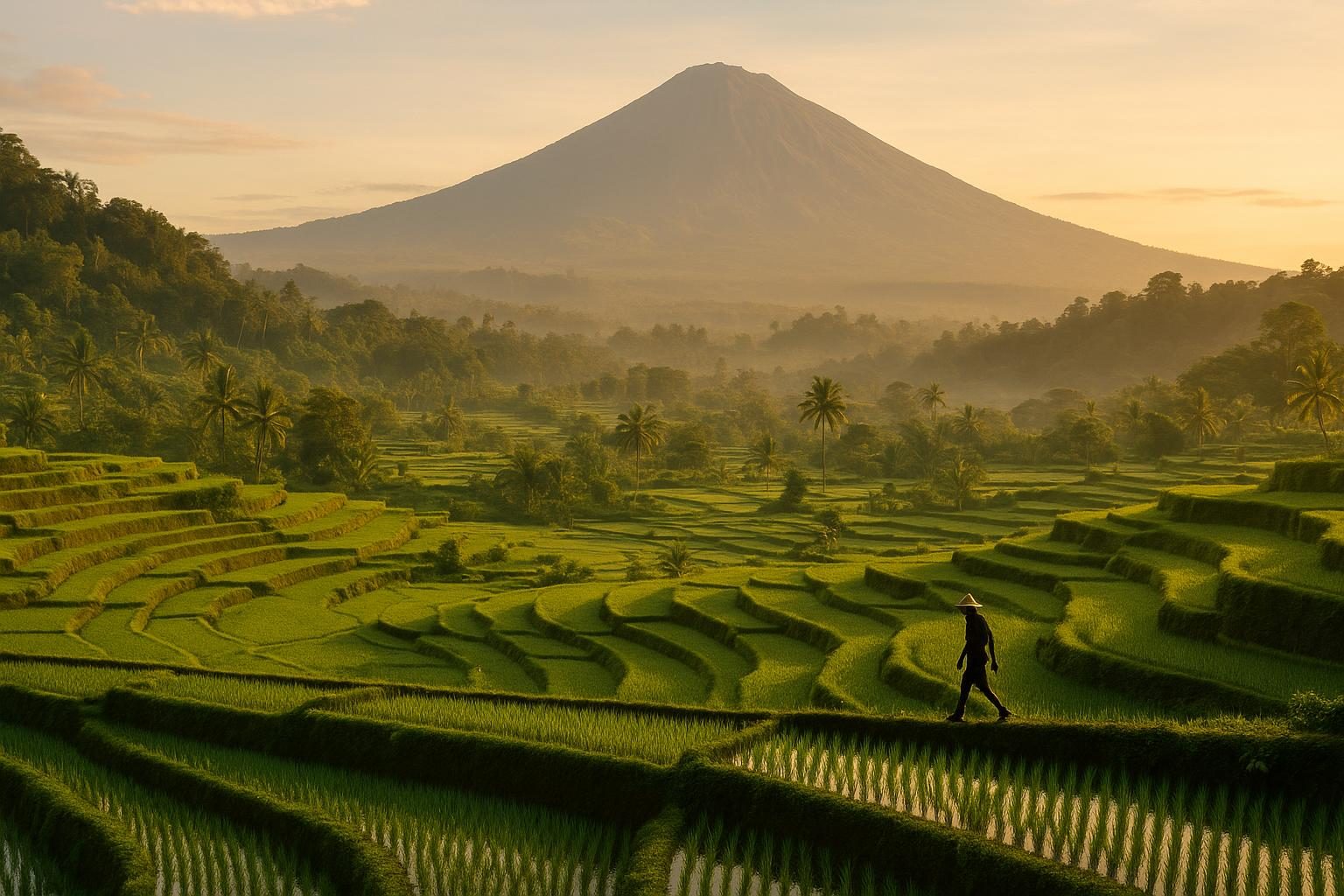
The hamlet of Iseh, 20 minutes north of Sidemen, is worth half a morning: a quiet traditional village in the landscape that Walter Spies made his home in the 1930s. A small compound marks the site; the views of Agung from the rice terraces here are superb. No entrance fee, no tourist infrastructure — just a village.
Klungkung (Semarapura)
The nearest significant town, Klungkung, is 20 minutes south of Sidemen and contains two genuinely important sites: Kerta Gosa (the royal hall of justice, with its famous wayang ceiling paintings depicting the consequences of sinful behaviour) and the adjacent Bale Kambang pavilion, set in a moat. Entry is inexpensive; the complex takes about 45 minutes and rewards a slow look.
The Klungkung market (best on market day, every three days following the Balinese calendar) is a proper working market — produce, textiles, dried goods, ceremonial supplies — not a tourist market.
Goa Lawah: The Bat Cave Temple
Pura Goa Lawah, 30 minutes south of Sidemen on the coast road, is one of Bali's six sad kahyangan directional temples — a complex built into and around a sea cave that shelters thousands of roosting fruit bats. The smell is pronounced but the spectacle at dusk (bats pouring from the cave) is memorable. Modest entrance fee; sarong required.
How to Organise the Days
Logistics: for destinations reachable in under an hour, a scooter (IDR 80,000–120,000/day) gives you maximum flexibility and is the locals' choice. Roads in east Bali are generally good condition, traffic is light outside Klungkung, and parking is free everywhere.
For a Lempuyang + Tirta Gangga full day — which involves an early start and significant walking — hiring a driver (IDR 400,000–600,000 for 8–10 hours) removes the fatigue of riding and lets you focus entirely on the sites. Most Sidemen guesthouses can arrange this with a day's notice.
A suggested two-day circuit from Sidemen:
Day 1: Early departure for Lempuyang gates (before 7 a.m.), then Tirta Gangga for a swim and late breakfast, back to Sidemen for an afternoon walk in the terraces.
Day 2: Besakih in the morning (7–8 a.m. for mountain views), lunch in Klungkung with a Kerta Gosa visit, Goa Lawah at dusk on the way back.
Everything is within reach. The valley makes an excellent base precisely because it sits at the geographic heart of east Bali's sacred landscape.
Explore more of east Bali's circuit from /region/sidemen.