Diving Nusa Penida: Crystal Bay, Mantas and Bali's Best Drift Dives
Nusa Penida sits in the Lombok Strait, where cold, plankton-rich upwellings meet warm coral seas — a combination that draws Mola Mola, manta rays and pelagic life that simply does not appear at other Bali dive sites. If you dive anywhere in Indonesia, make it here.
Diving Nusa Penida: Crystal Bay, Mantas and Bali's Best Drift Dives
The Lombok Strait, which separates Bali and Lombok, is one of the world's major oceanographic boundaries — the dividing line between the Indian Ocean and the Pacific. The cold, nutrient-rich upwellings that push through this channel collide with warm, shallow reef systems on Nusa Penida's coastline, creating conditions that support an extraordinary concentration of marine life. Nusa Penida diving is not just Bali's best; it ranks among Southeast Asia's most compelling.
This guide covers every major dive site, the logistical reality of diving here, the seasons that define what you will see, and the operators worth trusting.
Understanding the Conditions
Before sites, a note on what diving Nusa Penida actually involves: current. The Lombok Strait generates consistent, sometimes powerful currents that sweep around the island's headlands, and several of the best sites are drift dives — you enter, the current takes you, and you cover ground without finning.
Drift diving is exhilarating. It is also unforgiving if you do not understand it. Reversals, downwellings, and thermoclines (sharp cold layers, down to 18–20°C at Crystal Bay) are part of the reality here. Nusa Penida is appropriate for Open Water certified divers with experience in current, and ideal for Advanced Open Water and above. If you are on your first ten dives, the sites will still be beautiful, but go with an operator who is honest about conditions and will not push you into a site beyond your level.
Crystal Bay: The Mola Mola Site
Crystal Bay is arguably Nusa Penida's most famous dive site and the best place on earth to reliably encounter Mola Mola — the ocean sunfish, the world's heaviest bony fish.
Mola Mola are bizarre, ancient-looking creatures: a giant oval body, no tail, enormous dorsal and pectoral fins, and an expression of permanent surprise. Adults weigh up to 2,300 kilograms. They visit Crystal Bay's cleaning stations between July and October, drawn by the cold thermocline layers where the cleaning wrasse are active.
Diving Crystal Bay for Mola Mola requires descending to 18–28 metres, into water that may drop to 18–20°C without warning, and hovering in current while the fish are attended to by the cleaners. A five-millimetre wetsuit is strongly recommended.
Outside Mola Mola season, Crystal Bay remains an exceptional dive. The reef is healthy, visibility is typically 15–25 metres, and the bay itself hosts good coral, turtles, and the usual reef fish biodiversity. The channel beside the bay runs deeper and faster, suitable for more experienced divers seeking pelagics.
Best time: July–October for Mola Mola. Year-round for general reef diving. Depth: 5–30+ metres Certification: Open Water minimum; Advanced recommended for the channel
Manta Point: Pelagic Rays in Open Water
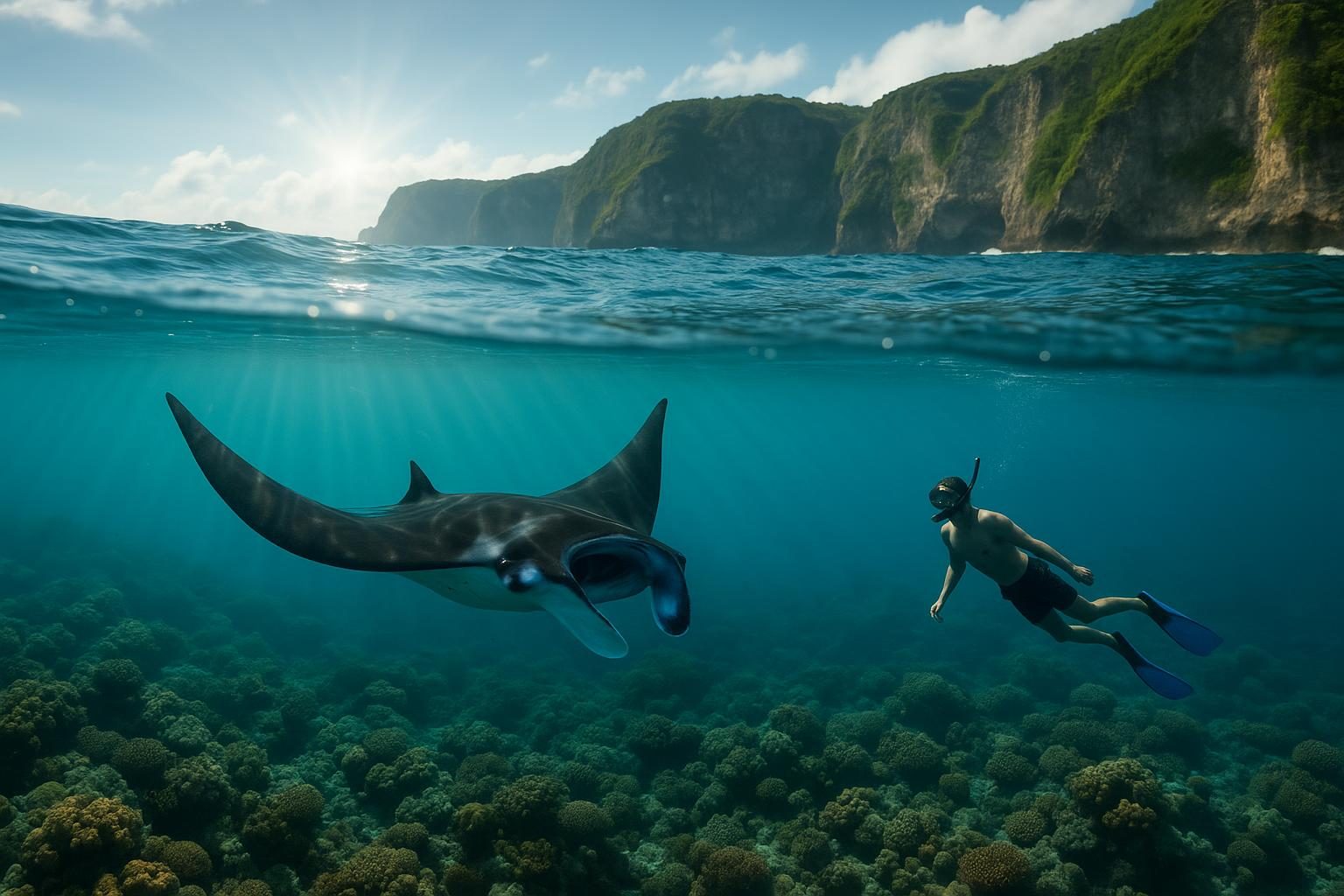
Covered in detail in our guide to Manta Point, this open-water site off Nusa Penida's southwestern headland is the island's most emotionally affecting experience — a cleaning station complex where oceanic manta rays (Manta birostris) congregate in significant numbers.
Manta Point is accessible year-round but at its best between May and October, when calmer seas improve both safety and visibility. Diving here puts you at the level of the rays rather than looking down from the surface — a meaningfully different encounter.
Depth: 5–18 metres at the cleaning stations Current: Moderate to strong; conditions dictate feasibility Certification: Open Water; comfort in current required
SD Point: Beginner-Friendly Drift
SD Point — named for the Sekolah Dasar (primary school) visible on the hillside above — is Nusa Penida's most accessible dive site for less experienced divers. The current runs along the wall in a consistent direction, making for pleasant, manageable drift diving with good coral cover and regular sightings of reef sharks, turtles, and Napoleon wrasse.
SD Point is often the second dive on a Crystal Bay day trip, and it is a reliable site even when conditions at the more exposed locations are difficult. The wall itself drops steeply from 5 to 30+ metres, with sea fans, soft coral, and swim-throughs in the shallower sections.
Best for: Open Water divers building current experience; anyone wanting a contrast to the deeper, colder sites. Depth: 5–30 metres Certification: Open Water
Gamat Bay: Macro and Muck Diving
Gamat Bay is the counterpoint to Nusa Penida's drift sites — a sheltered bay with calm, clear water ideal for macro diving. Nudibranchs, frogfish, ghost pipefish, mantis shrimp, and cuttlefish are all regular finds here, and the bay is accessible even when conditions elsewhere are rough.
Gamat is a good starting dive for the day — it lets you warm up, equalise properly, and tune in to the underwater environment before moving to the more demanding sites. It is also an excellent choice if you are diving with a less experienced buddy.
Toyapakeh: Wall and Drift
Toyapakeh, in the strait north of the island, is a long wall site with diverse marine life and some of the strongest currents on the island. This is a dive for experienced drift divers — current reversals are common, and the site demands solid buoyancy control.
On a good day, Toyapakeh delivers: massive schools of bumphead parrotfish, reef sharks, eagle rays, and the occasional hammerhead in the deeper water below the wall. It is not the site you come to for photos — the current makes that challenging — but as a pure diving experience, it is exceptional.
Depth: 5–40+ metres Certification: Advanced Open Water; drift experience essential
Best Season for Nusa Penida Diving
| Season | Highlights | Conditions |
|---|---|---|
| May–June | Mantas peak, good vis | Transitional; some chop |
| July–October | Mola Mola + mantas + best vis | Dry season, clearest water |
| November–April | Year-round species; fewer crowds | Rougher seas, reduced vis |
The honest answer: July and August are the peak diving months. Crystal Bay Mola Mola, Manta Point encounters, and visibility regularly above 20 metres coincide. Book operators well in advance.
Choosing a Dive Operator
Nusa Penida has dozens of operators ranging from excellent to negligent. The best ones share specific traits: honest condition briefings, equipment that is actually serviced, guides who know each site's currents, and group sizes small enough to mean something.
Based on Nusa Penida:
- Big Fish Diving — consistently recommended for safety, small groups, knowledgeable guides. PADI centre.
- Onus Dive School — good for courses and fun dives; strong guiding team.
- Nautilus Diving — popular with the technical diving crowd; covers the deeper Crystal Bay channel.
From Sanur (day trips to Nusa Penida):
Several established Sanur operators run day trips combining Crystal Bay and Manta Point — a longer day (7am departure, back by 5pm) but worthwhile if you are based in south Bali.
Prices: Two-tank fun dive from Nusa Penida: approximately 700,000–1,200,000 IDR including equipment. Crystal Bay Mola Mola specialist trips run higher. PADI Open Water courses: 4,500,000–6,000,000 IDR.
What to Pack for a Diving Day
- 5mm wetsuit — mandatory for Crystal Bay thermoclines, highly recommended everywhere
- Reef hook — essential for holding position in current without touching coral
- DSMB (surface marker buoy) — mandatory at most Nusa Penida sites; confirm your operator provides if you do not carry one
- Underwater torch — useful for wall crevices and Gamat Bay macro
- Reef-safe sunscreen — for the surface intervals; the boat time is long
Getting to Nusa Penida for Diving
See our complete guide to the crossing from Sanur. Most divers based on the island stay at Toyapakeh or nearby — there is a small cluster of dive-oriented accommodation within walking distance of the harbour, meaning you can be in the water by 8am without any travel stress. For day trippers from Bali, the first boat from Sanur arrives in time for a morning dive at Crystal Bay, but you will be working to a tight schedule.