The Salt Farmers of Amed: Inside Bali's Ancient Sea Salt Tradition
Discover how Amed's petani garam hand-harvest fleur de sel using centuries-old coconut trunks and volcanic black sand.
Where the Sea Becomes Salt
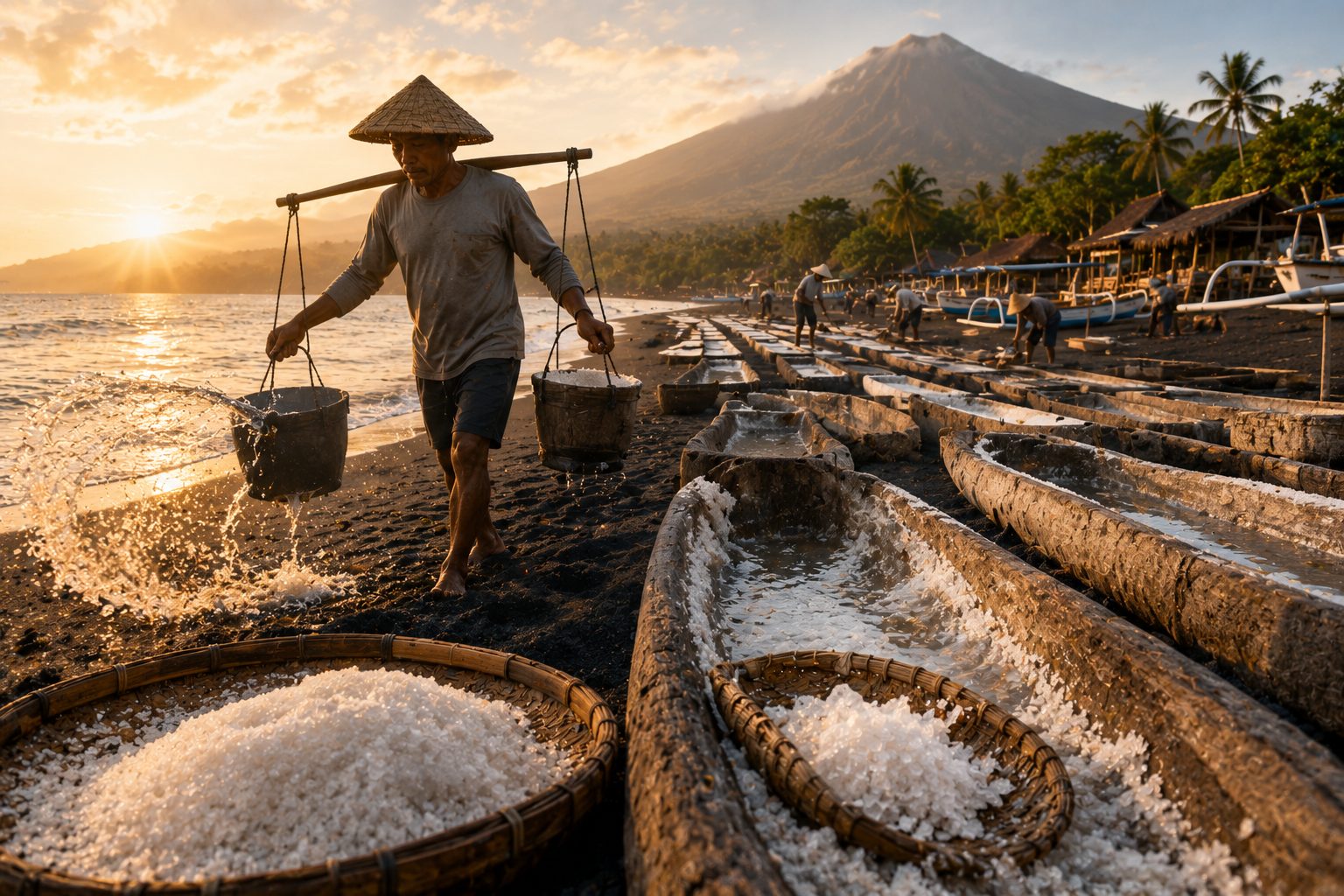
Before dawn breaks over the volcanic slopes of East Bali, a man fills a wooden bucket from the Indian Ocean, hoists it across his shoulders on a bamboo pole, and begins his day the same way his grandfather did — and his grandfather before him. On the dark, mineral-rich shoreline of Amed, the sun is the furnace, the ocean is the raw ingredient, and time is the only tool that cannot be hurried.
This is the world of the petani garam — Bali's traditional salt farmers — and their craft is one of the island's most quietly extraordinary living traditions.
Step by Step: How Amed Salt Is Born
The process reads like a love letter to patience.
Each morning, farmers carry seawater in heavy buckets and splash it in long, sweeping arcs across the beach's black volcanic sand. That sand is no ordinary substrate — rich in minerals deposited by nearby Mount Agung, it acts as a natural filter and concentrator. Under the fierce equatorial sun, the water evaporates quickly, leaving salt crystals clinging to every grain.
The salt-encrusted sand is then scooped into large wooden vats. Seawater is poured over it, percolating slowly downward through bamboo tubes, leaching out a dense, mineral-rich brine below. This is the heart of the liquid — salty, complex, alive with the character of the sea.
That brine is then poured into palungan: hand-carved troughs made from hollowed coconut tree trunks. Set out in rows on the beach, the palungan catch both sun and sea breeze. Over the next three to five days, the liquid slowly surrenders itself to evaporation. What remains are glittering white crystals — pure, unrefined, and kissed with trace minerals you will taste.
The finest outcome of all is the fleur de sel: delicate hollow pyramid crystals that form on the surface of the brine, harvested by hand before they can sink. Fragile enough to crush between two fingertips, they carry a faint oceanic sweetness that no industrial salt can replicate.
The People Behind the Salt
Salt farming in Amed is not simply an occupation — it is an identity rooted in centuries of history. Local records trace the tradition back to at least 1578, when Amed's saltmakers were appointed official suppliers to the Kings of the Karangasem Kingdom. That lineage is still felt in the way farmers speak about their craft: with quiet pride, and with a candid awareness that it may not survive another generation.
Today, only a handful of families in the villages of Amed and nearby Jemeluk still practice the full palung method. Tourism development, rising land values, and the punishing economics of artisan production — days of labour for modest returns — have led many to abandon the trade. Those who remain do so out of devotion as much as livelihood.
The tradition has earned formal recognition: Amed salt holds Geographical Indication status in both Indonesia and Europe, an acknowledgement of its unique provenance and irreplaceable character.
A Taste Unlike Any Other
Chefs who have discovered Amed salt describe it in the same breath as great finishing salts: flakey, bright, with a clean salinity and a soft mineral finish that lingers without bitterness. The pyramid crystals in particular dissolve slowly on the tongue, releasing flavour in layers.
In the kitchen, it shines as a finishing salt — scattered over a seared piece of fresh tuna, pressed gently into the top of dark chocolate, or simply dissolved into a bowl of steamed rice with coconut oil. Several fine restaurants and beach resorts across South Bali have begun sourcing it directly from Amed farmers, but most of the salt is still sold locally, to families in the surrounding villages who have cooked with it their whole lives.
Simple Ways to Use It at Home
- Finishing salt on grilled fish, avocado, or roasted vegetables
- Rim a glass of fresh lime juice or a tropical cocktail
- Baking: pressed into focaccia or sprinkled on caramel
- Gifting: a small bag of Amed fleur de sel is one of Bali's most meaningful and portable souvenirs
How to Visit — and How to Help
Salt production in Amed runs seasonally, roughly from June through October, when the dry season brings the long, cloudless days the process demands. During this window, visitors can walk directly onto the beach, watch the farmers at work, and — if welcomed — try their hand at splashing brine across the sand. It is unhurried, generous, and deeply grounding.
The Amed Salt Centre near Amed Beach offers a more structured introduction, with demonstrations and the chance to purchase salt directly from the producers. Buying from farmers or local cooperatives, rather than from airport gift shops, puts money where it matters most.
If you are visiting outside peak season, the palungan troughs are still visible along the shoreline, and locals are often happy to talk about their work.
A Grain of Something Irreplaceable
In a world of instant gratification, there is something almost radical about a food that takes days to make, demands perfect weather, and relies entirely on human hands and ancestral knowledge. Amed salt is not a novelty. It is a living archive — of a coastline, a kingdom, a way of reading the sky and the sea.
Taste it once, and you will understand why a few devoted families still walk down to the ocean before sunrise, buckets in hand, unwilling to let it disappear.