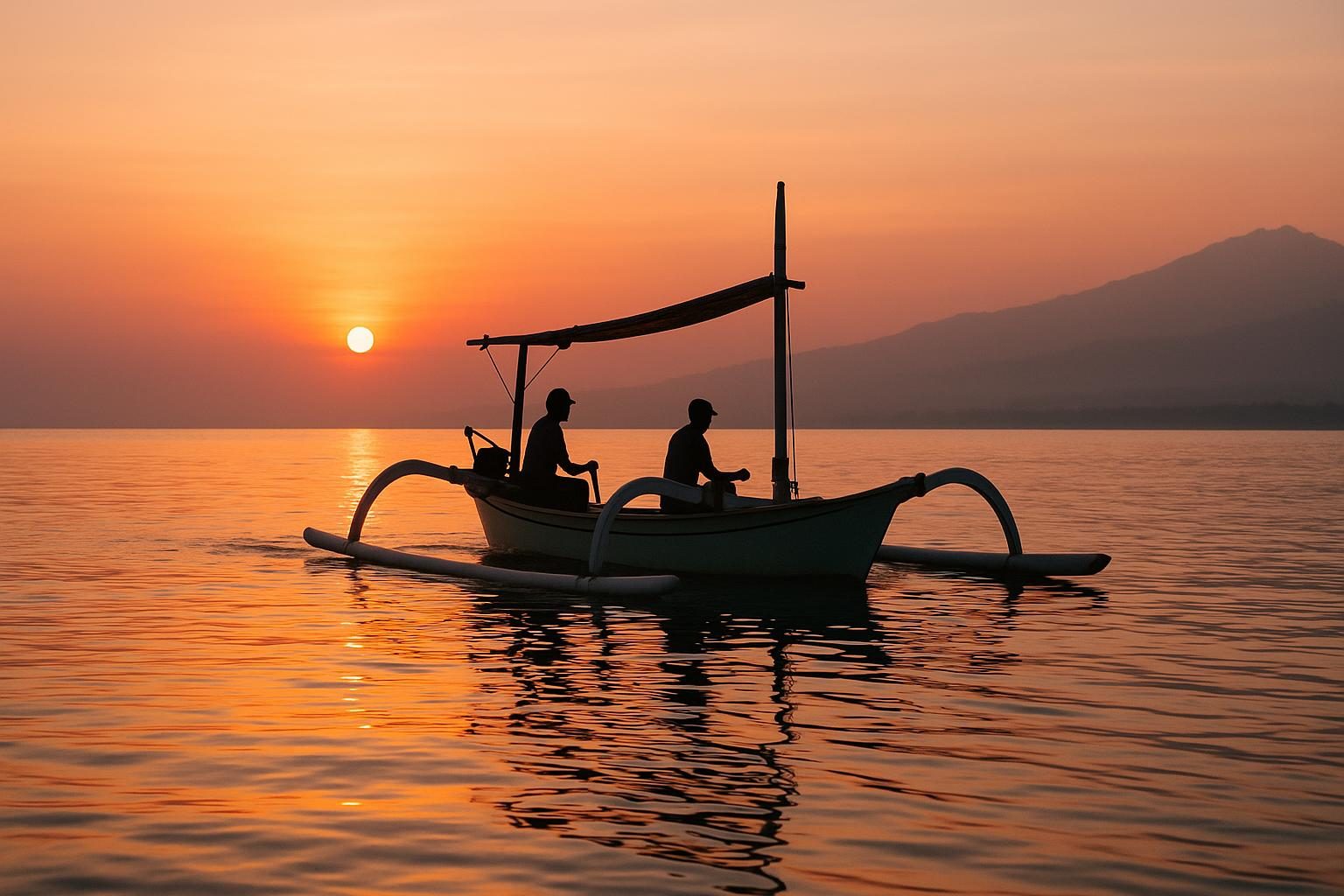
Lovina Sunrise Dolphin Watching: What to Really Expect
Wild spinner dolphins at sunrise on a black sand beach: how the Lovina boat tour really works, and how to dodge the crowds.
North Bali doesn't try very hard to impress you, and that's exactly the point. While the south fills up with beach clubs and traffic, Lovina stretches along a quiet black sand coastline where the main event happens before most of the island is even awake: wild spinner dolphins, breaking the surface in the pink light of sunrise, a few hundred metres from shore.
Why Lovina, Specifically
Lovina's dolphins aren't a show. They're a resident population of spinner dolphins (Stenella longirostris), with the occasional bottlenose dolphin passing through, that feed in the deep channel just offshore every morning. Fishermen here have been pointing them out to visitors since the 1980s, which is why nearly every guesthouse and warung along the strip can arrange a boat, and why the town's unofficial mascot — dolphin statues on the roundabout in Kalibukbuk — has been greeting arrivals for decades.
How the Tour Actually Works
Boats leave from the beach at 5:30–6:00am, timed so you're on the water as the sun comes up — both for the light and because dolphin activity tends to taper off later in the morning. Expect a 2 to 2.5 hour trip in a traditional outrigger jukung, with a captain who reads the water for fins rather than following a fixed route.
Pricing is informal and negotiated beach-side or through your hotel, so treat any number as indicative rather than fixed:
- Shared boat: roughly IDR 100,000–150,000 per person
- Private boat: roughly IDR 350,000–500,000 for up to 3 people, with a small surcharge per extra passenger
- Add-ons: snorkelling over the nearby reef (~IDR 60,000) or a swim-with-dolphins add-on (~IDR 100,000) where conditions allow
A second departure around 9am exists for late risers, but the early boat has calmer seas and, usually, more dolphins.
The Part Worth Knowing Before You Book
Reviews of Lovina are genuinely mixed, and it's worth reading them before you go. On a busy morning, 50 or more boats can converge on the same small pod, engines idling around the animals from several directions — which is stressful for the dolphins and underwhelming for you. If you want a better version of the same experience:
- Book a later or private departure. Fewer boats means the captain can hold back and let the pod come to you instead of chasing it.
- Choose an operator who cuts the engine near dolphins rather than trailing them at speed — ask directly before you book. Lovina Dolphin Tours is one local operator that markets a slower, small-boat approach.
- Don't touch or feed the dolphins, even if other boats do. They're wild animals in open water, not an attraction.
Getting There and Where to Base Yourself
Lovina sits on Bali's north coast, about 2.5 to 3 hours by car from Ubud or the southern beach towns, via the mountain road through Bedugul — itself a scenic detour past crater lakes and roadside strawberry stalls. Perama shuttle buses and private drivers both run the route daily; there's no need to rent your own car unless you're continuing further along the north coast afterwards.
Because the boats leave straight from the sand at dawn, where you sleep matters more here than almost anywhere else in Bali. Lovina Beach Hotel sits directly on the beach in the middle of the strip, which turns a 5am alarm into a short walk instead of a scramble for transport.
After the Boat Comes In
By 8am you're back on land with the rest of the day ahead of you and, frankly, ready for a nap. A short massage takes the edge off — Aneka Lovina Villas & Spa has a spa open to non-guests for exactly this kind of post-sunrise reset. Afterwards, it's worth wandering the Kalibukbuk village strip for a late breakfast, or driving 20–30 minutes inland to Gitgit waterfall or the Banjar hot springs if you have a car for the day.
Practical Tips
- Best months: the dry season, roughly April to November, brings calmer seas and clearer mornings, which means better dolphin sightings.
- Bring: reef-safe sunscreen (apply it the night before if you can — sunrise light is deceptively strong), a light layer for the boat ride out, and a dry bag for your phone.
- Motion sensitivity: the open-water swell can be choppy even on calm mornings; if you're prone to seasickness, sit low and central in the boat and keep your eyes on the horizon.
- Set expectations: dolphins are wild and not guaranteed on every trip, though sightings are frequent. Treat a confirmed encounter as a highlight, not a promise.
Lovina won't give you a curated wildlife encounter with a script and a photographer waiting on the dock. What you get instead is an early alarm, a quiet black sand beach, and — more mornings than not — a pod of wild dolphins doing exactly what they'd be doing whether you showed up or not.